
Interest Rates, Inventory, and Timing: How to Buy Smart This Month in Central Florida

Buying a home today means navigating a landscape that’s different from even a few years ago. Interest rates, inventory levels, and market timing are three forces that shape your purchasing power — and if you understand how they work together, you can make smarter decisions that save money, reduce stress, and position you for long-term equity.
This is especially true in Central Florida, where dynamic job growth, population influx, and limited housing supply continue to put pressure on housing demand.
In this post, we’ll break down:
- Why interest rates matter (and how they affect your buying power)
- Where inventory stands right now in Central Florida
- How timing can impact price and competition
- Strategies for buying smart this month (with real examples)
Whether you’re a first-time buyer, relocating buyer, or seasoned investor, this guide will help you make informed decisions in a fast-moving market.
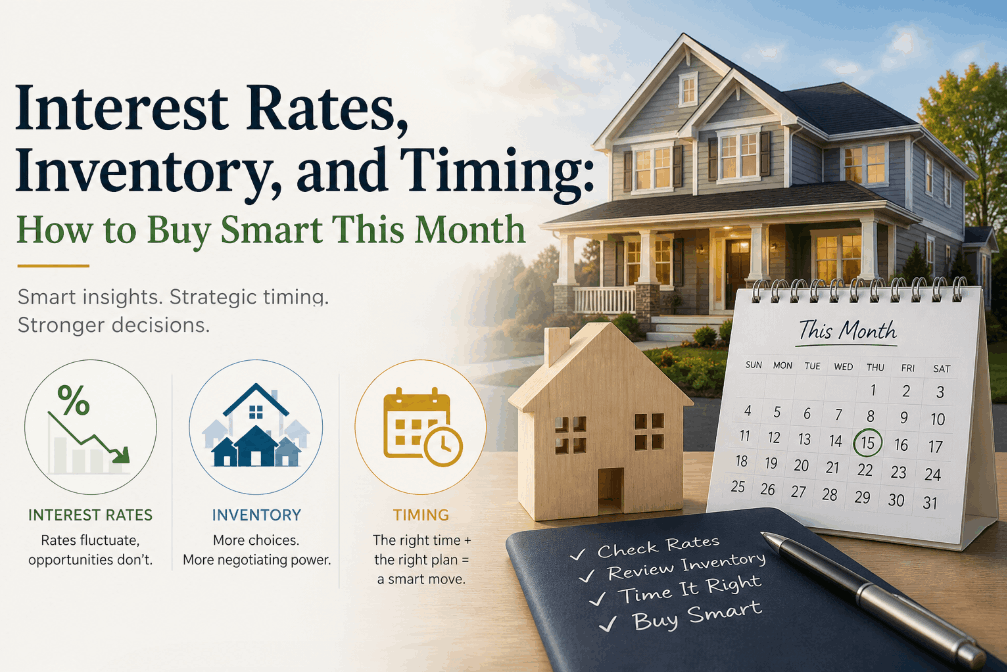
🔹 1. INTEREST RATES: Why They Matter More Than Ever
Interest rates are one of the biggest levers affecting what you can afford. They don’t change the home price — but they do change what your monthly payment looks like, and what you can comfortably qualify for.
🧠 What Interest Rates Impact
- Monthly mortgage payment — even a small rate change can add or subtract hundreds per month.
- Total cost of the loan — a 30-year mortgage at 7% vs 6% can cost tens of thousands extra in interest.
- Buying power — lower rates usually mean you can afford a more expensive home without increasing your monthly payment.
📉 Current Central Florida Reality
In 2026, interest rates have been more stabilized than in the highs seen in recent years, but they’re still not in the historic lows of the early 2020s.
For example:
- On a $400,000 home with 20% down:
- 6.25% rate → $2,013/month principal + interest
- 7.00% rate → $2,330/month principal + interest
That’s over $300/month difference — or $3,600/year in additional cost.
🛠 How Buyers Can Respond
✔ Get pre-approved before shopping
✔ Lock the rate when you find your home
✔ Consider shorter-term points or buy-downs if rates are high
✔ Align your purchase timeline with your financial goals
Understanding rates helps you calibrate expectations before falling in love with a home that might stretch your budget.
🔹 2. INVENTORY: The Hidden Force Driving Competition
Inventory refers to the number of homes for sale at any given time. In Central Florida, inventory has been tight — especially for move-in-ready homes in desirable areas.
🏡 What Low Inventory Means
- Fewer choices for buyers
- More competition on well-priced homes
- Higher chances of multiple offers
- Stronger need for smart pricing and strategy
📊 Central Florida Inventory Snapshot
While exact numbers shift weekly, broad trends in 2026 show:
- Starter homes (under $400K): high demand, low inventory
- Mid-range homes ($400K–$600K): balanced but competitive
- Move-in-ready, turnkey properties: especially scarce
Buyers who are ready — with financing lined up and criteria clearly defined — are the ones winning offers in this market.
🧠 Inventory Tip
A home priced correctly in a low-inventory environment often gets:
✔ More showings
✔ Faster offers
✔ Better terms
✔ Potential bidding scenarios
That’s why buyers need a combination of price realism and strategic offer presentation.
🔹 3. TIMING: Why It Matters More Than You Think
Timing isn’t just about the season — it’s about where markets are in the buying cycle, inventory shifts, and rate movement.
📆 Seasonal Influences
In Central Florida:
- Spring & early summer typically have the most activity
- Late fall & winter can be quieter but still active (unique to Florida’s lifestyle demand)
Unlike snow-belt markets where winter can slow almost completely, Florida continues to have steady buyer demand year-round — especially from relocation buyers and retirees.
📈 Market Phases
We can think of the market as moving through phases:
- Seller’s Market: low inventory, strong buyer demand, multiple offers
- Balanced Market: inventory and demand are evenly matched
- Buyer’s Market: excess inventory, more negotiating power for buyers
Central Florida fluctuates between seller’s and balanced conditions depending on neighborhood and price bracket — but in 2026, most segments still favor sellers overall.
🔹 4. HOW TO BUY SMART THIS MONTH
Knowing the facts is one thing — applying a smart strategy is another. Let’s break down actionable steps buyers should take now.
🧠 A. Get Your Finances in Order First
Before you begin touring homes:
- Get pre-approved, not just pre-qualified
- Understand your down payment strategy
- Build a cushion for inspection repairs or negotiation
- Know your non-negotiables (price, location, features)
Buyers with pre-approval often get first looks and stronger positioning in competitive situations.
📍 B. Look Beyond Just Price — Consider Value
Not all $400,000 homes are the same. Two homes listed at the same price can be worlds apart in:
- Condition
- Location and commute time
- School district
- Utility and insurance costs
- HOA fees
- Future resale potential
For example:
- A home near major job hubs with walkability and amenities may hold value better than one farther out — even if the price is the same.
Value isn’t just price — it’s the total ownership picture.
💡 C. Be Ready to Move Quickly on Strong Listings
In a low-inventory market, great homes don’t last long. You can prepare by:
✔ Touring homes soon after they hit the market
✔ Communicating clearly with your agent about priorities
✔ Having your financial documents ready
✔ Being open to negotiation strategy
This doesn’t mean making an impulsive decision — it means being ready and informed so an opportunity doesn’t slip away.
📑 D. Don’t Get Caught in Bidding Wars Blindly
Bidding wars can be intimidating — but smart buyers approach them strategically:
- Understand the comps and neighborhood pricing trends
- Set a firm maximum based on budget, not emotion
- Consider escalation clauses when appropriate
- Clarify terms (closing date, inspection timelines, earnest money)
A strong offer is not always the highest — it’s the one that aligns with seller needs and reduces friction.
🛠 E. Consider Homes That May Need Light Updates
In markets with lower inventory, homes needing light cosmetic updates often present:
- Lower competition
- Price savings
- Opportunity for personalization
But be careful: heavy renovation properties only make sense if you’ve factored in time, cost, and potential permits.
🔹 5. REAL EXAMPLES: What Buying Smart Looks Like
💡 Scenario 1: Buyer A — Savvy on Rates
Buyer A got pre-approved, locked a competitive rate early, and aligned their budget so that they hit peak affordability. They saw a home they loved, submitted a strong but reasonable offer, and negotiated a quick closing — saving on interest and getting a home before rates ticked up.
📍 Scenario 2: Buyer B — Ready for Value
Buyer B focused on neighborhood value — choosing a home slightly outside core Orlando but with better schools, yard space, and long-term growth prospects. They avoided the most competitive bidding zones and still gained equity advantages.
🔹 6. WATCHING WHAT’S NEXT: RATE & INVENTORY FORECASTS
No one has a crystal ball — but smart buyers watch trends:
📉 Rate Signals
- Federal policy shifts
- Market movement
- Mortgage business conditions
A slight dip in rates can increase buying demand, tighten inventory further, and push pricing upward — so timing matters.
🏘 Inventory Signals
- New listings volume
- Days on market
- Offer activity
- Price reductions
If inventory rises, buyers gain negotiating leverage. If it tightens, the market becomes more competitive.
🏁 FINAL THOUGHTS: Buying Smart in Central Florida Right Now
The best buyers aren’t the ones who act fastest — they are the ones who act smartest.
To approach this market with confidence:
- Understand how interest rates affect your budget
- Recognize where inventory is tight
- Use timing to your advantage
- Get financially prepared before you start
- Focus on value, not just price
- Be ready to negotiate strategically
In 2026, Central Florida remains a strong opportunity for homebuyers — but the landscape requires thought, strategy, and awareness of current conditions.
If you’d like a personalized buying strategy, including rates outlook, inventory snapshots, and neighborhood comparisons, just let me know — I’d be happy to help you develop a plan that fits your goals.
Categories
Recent Posts






ARE YOU LOOKIING TO SELL YOUR HOME FOR TOP DOLLAR? CLICK THE BUTTON BELOW TO GET STARTED
SELL YOUR HOME