
How to Win a Bidding War in a "Balanced" Market
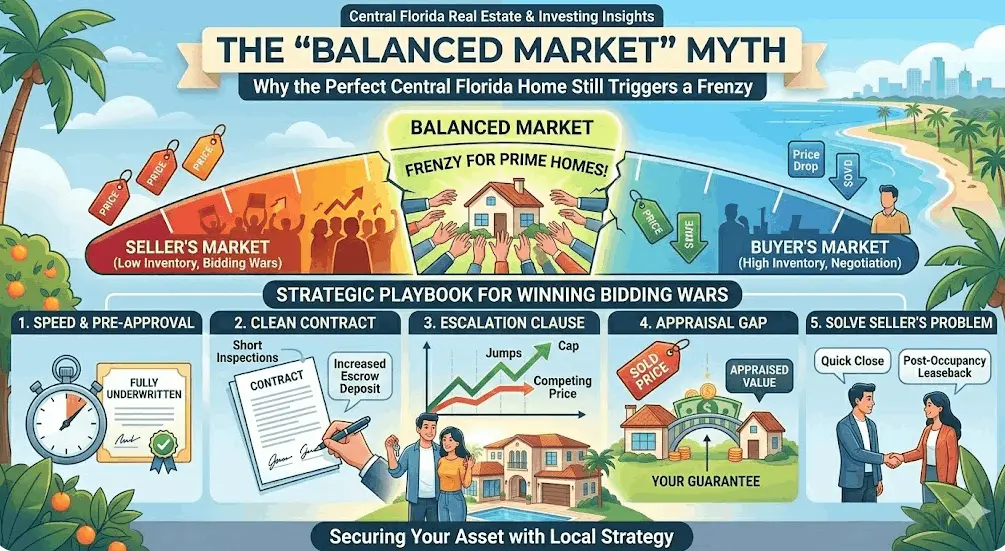
In the real estate world, we often talk about "Seller’s Markets" (where inventory is low and prices skyrocket) or "Buyer’s Markets" (where homes sit and prices drop). But right now, much of Central Florida is settling into a Balanced Market.
On paper, this sounds calm. In reality, the "perfect" house—the one with the updated kitchen, the pool, and the A-rated school zone—will always create a feeding frenzy. Even when the broader statistics say things are equal, high-demand properties still trigger bidding wars.
If you’ve found "the one," you can’t afford to be casual. Here is your strategic playbook for winning a bidding war when the scales are even.
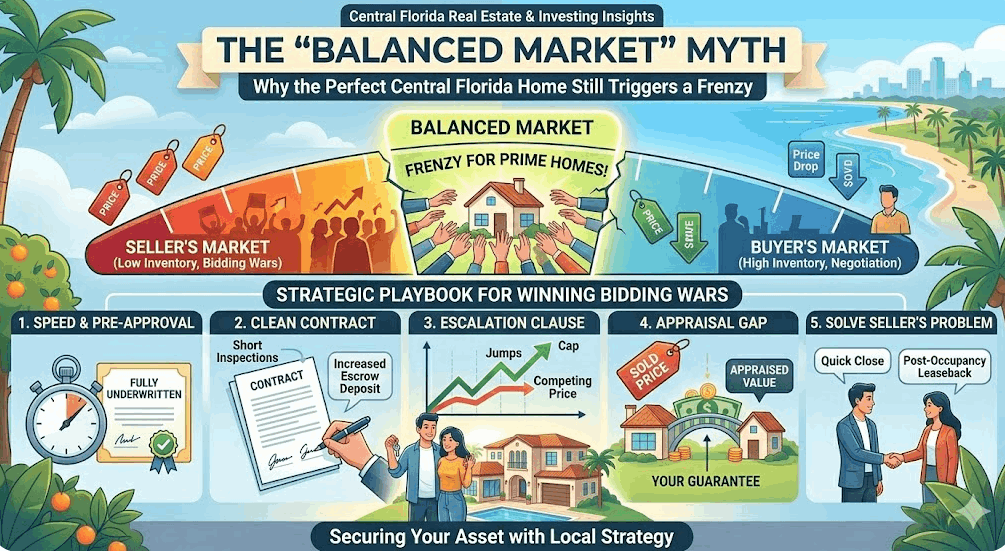
1. Understand the "Balanced" Nuance
In a balanced market, the "Days on Market" (DOM) average might be 45 days. However, that is an average. A property priced correctly in a prime Orlando zip code might still go under contract in 48 hours.
The Fact: According to recent Florida Realtors® data, while inventory has risen, well-priced homes are still seeing multiple offers within the first week.
The Strategy: Don't let the "balanced" label give you a false sense of security. If a home has been on the market for 3 days, treat it like a seller's market. If it’s been there for 60 days, you have the leverage.
2. Speed is Your Silent Partner
In a bidding war, the first clean offer often sets the benchmark. If you wait until the Sunday Open House to "think about it," three other buyers have already submitted digital signatures.
-
Get "Tritium" Pre-Approved: Don’t just get a pre-qualification. Get a fully underwritten pre-approval. This tells the seller that your finances have already been vetted by an underwriter, making your offer as close to cash as possible.
-
The "Pocket Listing" Edge: Work with an agent (like myself!) who has deep roots in Central Florida. Sometimes, knowing about a listing 24 hours before it hits the MLS is the difference between winning and losing.
3. Master the "Clean" Contract
Price is important, but terms often win the deal. In a balanced market, sellers are looking for the path of least resistance.
Shorten the Inspection Period
The standard Florida "AS-IS" contract often defaults to a 15-day inspection period. To a seller, that’s 15 days the house is off the market while you decide if you want it.
-
Winning Move: Shorten this to 7 or 10 days. It shows you are serious and won't drag your feet.
Increase the Escrow Deposit (EMD)
A standard deposit might be 1% of the purchase price.
-
Winning Move: Put down 2% or 3%. This "earnest money" stays in an escrow account, but it signals to the seller that you have significant "skin in the game" and are unlikely to walk away for a minor reason.
4. Use an Escalation Clause (With Caution)
An escalation clause is a powerful tool in a multi-offer scenario. It essentially says: "I will pay $X for this home, but if you receive a higher legitimate offer, I will beat it by $2,000, up to a maximum of $Y."
Example:
Your Base Offer: $500,000
Escalation: $2,000 over any competing offer.
Cap: $525,000.
If another buyer offers $510,000, your offer automatically becomes $512,000. This keeps you in the running without immediately jumping to your maximum budget.
5. The "Appraisal Gap" Guarantee
In Central Florida, we’ve seen rapid shifts in valuations. A seller’s biggest fear in a bidding war is that the house sells for $550,000, but the bank appraises it for $530,000, leaving a $20,000 hole.
In a balanced market, you can win by offering an Appraisal Gap Guarantee. You promise to cover a specific amount (e.g., $5,000 or $10,000) out of pocket if the appraisal comes in low. This gives the seller peace of mind that the deal won't collapse at the eleventh hour.
6. Personalize (But Keep it Professional)
While some states have moved away from "buyer love letters" due to fair housing concerns, a professional cover letter from your agent can still work wonders.
Instead of a generic email, I present your offer as a comprehensive package. We highlight your strong financing, your flexibility on the closing date, and your genuine appreciation for the home’s upkeep. Sometimes, a seller chooses the "cleaner" buyer over the "slightly higher price" buyer because they want a smooth, stress-free closing.
7. Solve the Seller's Problem
Every seller has a "pain point."
-
The Relocator: They might need a quick 30-day close.
-
The Builder: They might be building a new home that won't be ready for 60 days and need a Post-Occupancy Leaseback (where they stay in the house for a month after closing).
The Fact: Offering a flexible closing date or a "leaseback" can be more valuable to a seller than an extra $5,000 in the purchase price. By aligning your timeline with theirs, you move to the top of the pile.
8. The Power of "No Repairs" (To a Point)
In a balanced market, you don't necessarily want to waive the inspection—that's risky. However, you can include a clause stating you won't ask for repairs under a certain dollar amount (e.g., $2,500).
This tells the seller: "I’m not going to nickel-and-dime you over a leaky faucet or a cracked floor tile. I’m here for the house, not a renovation credit."
Final Thoughts for Central Florida Buyers
Winning a bidding war in a balanced market isn't about being the most aggressive; it’s about being the most strategic. It requires a blend of local market data, financial readiness, and a contract that favors the seller’s convenience without sacrificing your protection.
Whether you're looking for an investment property in Kissimmee or a forever home in Downtown Orlando, the goal is the same: Secure the asset at the best possible terms.
Categories
Recent Posts









ARE YOU LOOKIING TO SELL YOUR HOME FOR TOP DOLLAR? CLICK THE BUTTON BELOW TO GET STARTED
SELL YOUR HOME