
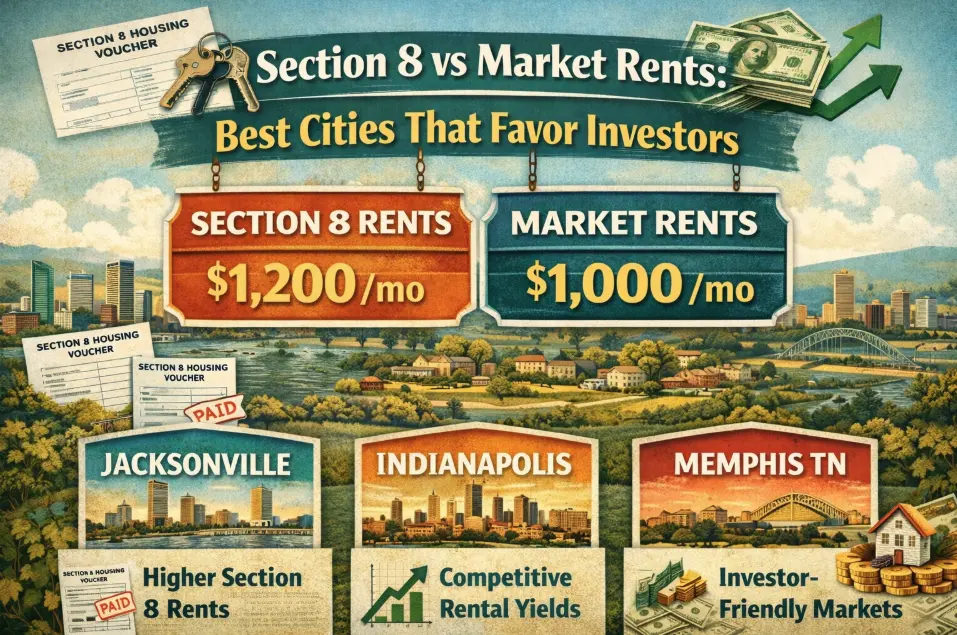
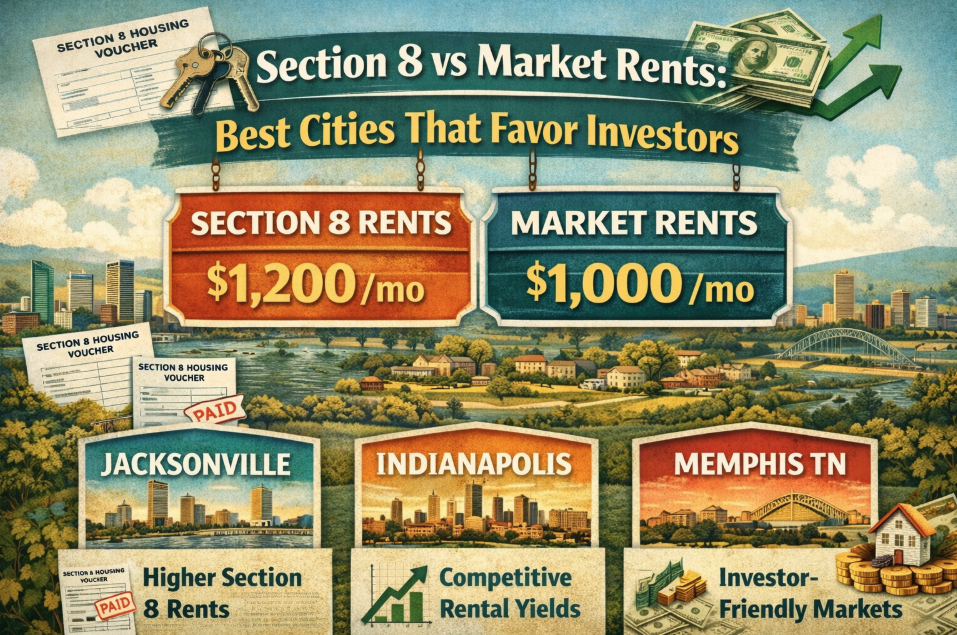
Section 8 vs Market Rents: Best Cities That Favor Investors
Investing in rental properties is always about balancing risk, return, and tenant stability. For many investors, the question isn’t just “Where should I buy?” but “Should I focus on market-rate tenants or Section 8 tenants?”
While market-rate rentals can offer flexibility and sometimes higher rents, Section 8 investments provide guaranteed government-backed payments, lower vacancy rates, and long-term tenant retention. The key is finding cities where Section 8 rents are competitive—or even superior—compared to market rents.
In this article, we’ll explore the differences between Section 8 and market-rate rents, the factors that make certain cities favorable for investors, and specific markets—especially in Florida—that maximize cash flow opportunities.
Understanding Section 8 vs Market-Rate Rents
Section 8, or the Housing Choice Voucher Program, is designed to help low-income families afford safe housing. The government pays a portion of the rent directly to the landlord, and tenants pay the remainder based on their income.
Key differences that affect investor decisions:
| Factor | Market Rent |
|---|---|
| Rent Payment | Paid entirely by tenant |
| Vacancy Risk | Dependent on market demand |
| Tenant Turnover | Often higher |
| Rent Ceiling | Flexible |
| Inspection | Optional |
Understanding these differences helps investors identify cities where Section 8 rents either match or exceed comparable market rents, creating strong cash flow potential.
What Makes a City Favorable for Section 8 Investors?
Several factors make certain cities better suited for Section 8 rentals:
- Competitive HUD Rents Relative to Local Market
- Cities where HUD-approved rents are at or above market rates maximize cash flow for Section 8 properties.
- Strong Section 8 Demand
- Look for cities with high voucher utilization and long waiting lists.
- These markets often experience low vacancy and consistent rental income.
- Affordable Home Prices
- Cash flow is strongest in cities where property prices are reasonable relative to the Section 8 rent potential.
- Population and Job Growth
- Cities with growing populations, especially working-class households, generate sustained demand for affordable rentals.
- Landlord-Friendly Regulations
- Cities with clear inspection processes and minimal rent control make compliance easier and reduce risk.
Best Cities Favoring Investors: Section 8 vs Market Rents
1. Lakeland
- Market Rent vs Section 8 Rent:
- 3-bedroom home: Market rent ~$1,900 | Section 8 ~$2,050
- Why investors like it:
- Lower purchase prices than Tampa or Orlando
- Strong logistics, distribution, and warehouse job growth
- HUD rents often exceed local market rents, increasing cash flow
2. Ocala
- 3-bedroom home: Market rent ~$1,750 | Section 8 ~$1,950
- Affordable homes combined with competitive HUD rents make Ocala a prime Section 8 market.
- Newer construction and family neighborhoods meet HUD inspection standards easily.
3. Deltona
- 3-bedroom home: Market rent ~$1,750 | Section 8 ~$1,950–$2,100
- Suburban growth driven by Orlando spillover and local service jobs
- Multi-bedroom homes are especially attractive for voucher tenants
4. Kissimmee
- Market rent: ~$2,300 | Section 8: $2,400+
- Proximity to Orlando’s tourism industry supports higher HUD rents
- Section 8 tenants often pay the same or less than market, but rent is guaranteed and long-term
5. Haines City
- Market rent: ~$1,850 | Section 8: $2,000+
- Newer subdivisions pass inspections easily
- Population growth supports long-term rental demand
Why Section 8 Can Outperform Market Rents
Investors sometimes assume market-rate rentals always generate higher cash flow. However, in many emerging and secondary markets, Section 8 rents often exceed comparable market rents, particularly for:
- 3–4 bedroom family homes
- Properties near employment corridors
- Areas with limited affordable housing supply
*Top 10 Section 8 Markets* outside of Florida, with Birmingham included:
1. Birmingham, AL
- If your primary goal is maximum rental income, Birmingham is a city you absolutely need to consider — certain properties here can yield as much as 13.6%. Low entry prices combined with a strong rental market are the secret sauce.
2. Memphis, TN
- Memphis consistently tops Section 8 investor lists. The Memphis Housing Authority processes inspections within 15 business days on average. With a metro population of 1.34 million and logistics-driven job growth from FedEx and Amazon, tenant demand remains strong. Property taxes run roughly 1.1% of assessed value.
3. Detroit, MI
- Detroit offers relatively high cash flow potential with a median sold home price around $95,300. Assuming a 20% down payment at a 6% rate, you could expect roughly $634/month cash flow before expenses just on median properties.
4. Columbus, OH
- Columbus blends strong fundamentals with growing population — rare for a high-yield Section 8 market. Intel's $20B chip plant and Ohio State University drive 1.4% annual population growth. The Columbus Metropolitan Housing Authority administers over 13,000 vouchers, with stronger appreciation upside than Cleveland.
5. Cleveland, OH
- Cleveland is a standout for cash flow, anchored by the Cleveland Clinic. It offers low entry costs and consistent rental demand, with some reports showing rental yields around 9.8%.
6. Indianapolis, IN
- Indiana has a constitutional cap of around 1-2% on property taxes for rentals, offering fantastic predictability.
7. San Antonio, TX
- San Antonio's metro population surpassed 2.6 million in 2025, growing at 1.8% annually. The San Antonio Housing Authority manages approximately 13,500 vouchers, and military installations provide a steady stream of voucher-eligible tenants.
8. Kansas City, MO
- KC straddles two states. Focus on the Missouri side for lower property taxes — Jackson County's effective rate is around 1.3%. The Housing Authority of Kansas City administers roughly 6,800 vouchers, backed by tech and logistics job growth.
9. St. Louis, MO
- For investors prioritizing affordability and immediate cash flow, St. Louis is a fantastic option. Home prices are often 40–50% below national averages. Certain neighborhoods are still seeing the 1% Rule in action — a landlord's dream for cash flow.
10. Milwaukee, WI
- Milwaukee's HAP standards have increased 12% since 2023, outpacing home price appreciation of 8%. The Housing Authority of the City of Milwaukee administers approximately 8,200 vouchers. Target the Northwest Side and West Allis for optimal acquisition pricing.
Bottom line:
Birmingham is the #1 pure cash flow Section 8 market in the country right now. The Midwest and Mid-South dominate this list for a reason — low buy-in, government-backed rent, and landlord-friendly laws are a powerful combination.
Tips for Maximizing Section 8 Returns
- Focus on Multi-Bedroom Homes
Section 8 tenants often need 3–4 bedrooms, which allows for higher HUD rents and lower turnover than single-bedroom rentals. - Partner with Experienced Property Managers
Navigating inspections, compliance, and tenant turnover is critical. A manager familiar with local housing authorities ensures consistent rent and reduces headaches. - Target Established Neighborhoods
Properties in neighborhoods with strong schools and low crime rates are more likely to pass inspections and retain tenants long-term. - Analyze Cash Flow Thoroughly
Factor in mortgage, insurance, property management, and repairs to calculate true net income before purchasing.
Risks to Consider
Even in favorable cities, Section 8 investing requires careful planning:
- HUD inspections are required and properties must meet minimum standards.
- Voucher processing delays can temporarily affect cash flow.
- Local housing authorities vary in efficiency; some can take longer to approve leases.
Mitigating these risks through pre-inspections, property upgrades, and experienced management is essential.
Final Thoughts
For investors seeking reliable cash flow with lower vacancy risk, Section 8 rentals can outperform market-rate properties—especially in cities where HUD rents meet or exceed market rates.
Florida, in particular, offers several high-potential markets, including Lakeland, Ocala, Deltona, Kissimmee, and Haines City, where Section 8 rents are strong relative to property prices. By targeting these markets and focusing on multi-bedroom, inspection-ready homes, investors can build a stable, long-term income portfolio while serving families in need of affordable housing.
Categories
Recent Posts





ARE YOU LOOKIING TO SELL YOUR HOME FOR TOP DOLLAR? CLICK THE BUTTON BELOW TO GET STARTED
SELL YOUR HOME