
Tampa and Orlando Transportation Projects Impacting Growth
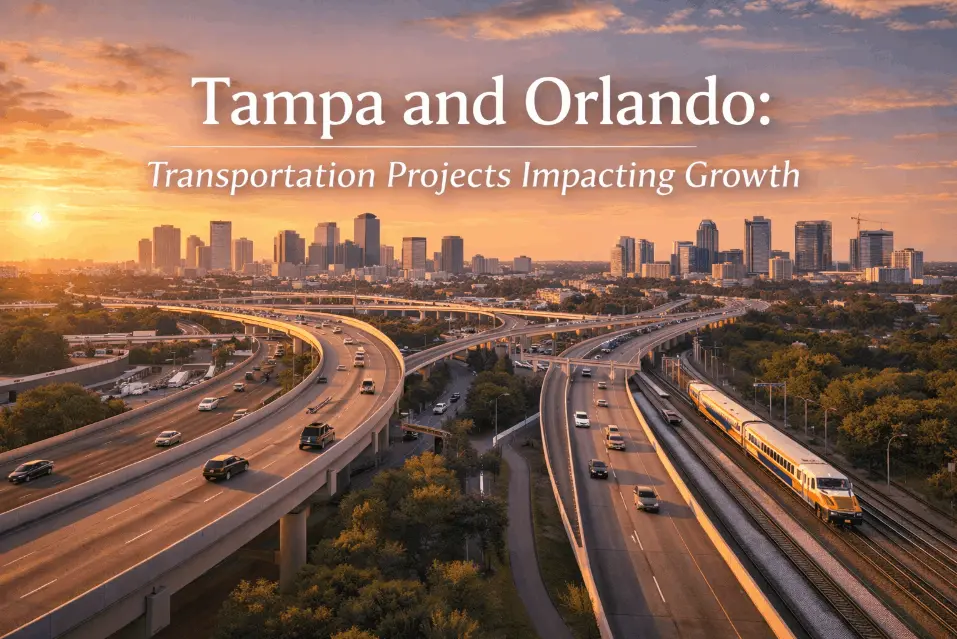
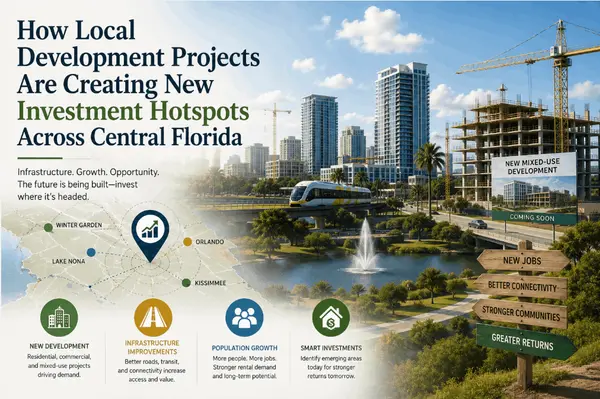
As Central Florida continues to grow into one of the nation’s fastest-expanding economic regions, transportation infrastructure is playing an increasingly important role — not just in moving people, but in shaping where people choose to live, work, invest, and start businesses. From major highway upgrades to proposals for enhanced rail connectivity between Orlando and Tampa, transportation projects are helping unlock new development opportunities, improve commute times, and support broader economic expansion across the region.
In this article, we’ll explore the key transportation initiatives underway in both Orlando and Tampa — why they matter, and how they are influencing regional growth patterns.
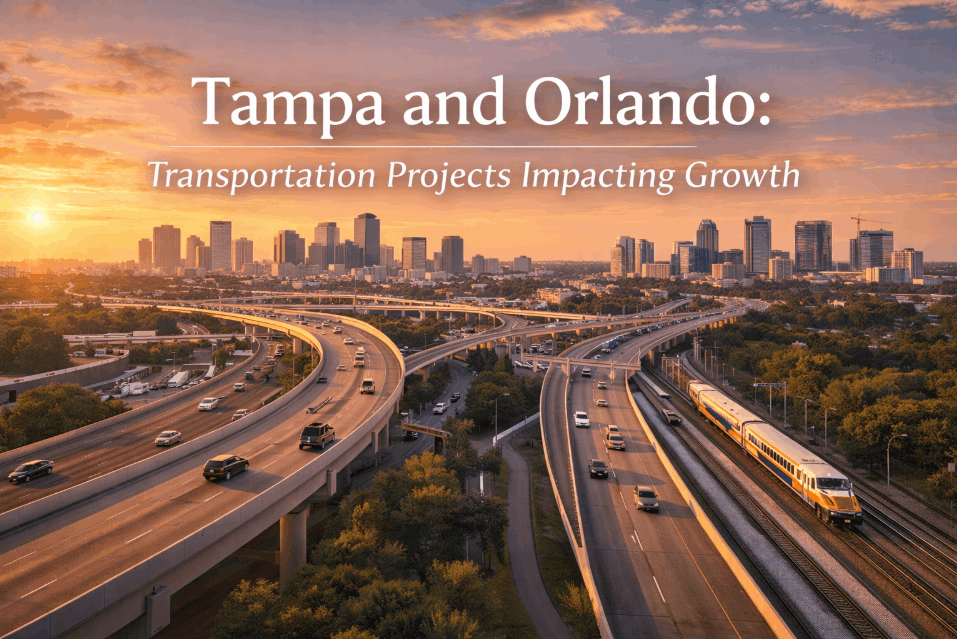
🚗 The I-4 Corridor — Florida’s Economic Backbone
Perhaps no transportation route is as central to Florida’s economic growth as Interstate 4 (I-4), the major highway linking Tampa with Orlando and beyond. The I-4 corridor supports a massive portion of the state’s population and commerce, serving more than 8 million residents and tens of millions of annual visitors — and anchoring one of the busiest freight and logistics routes in the Southeast.
Because of this, transportation enhancements to I-4 aren’t just about moving vehicles — they’re about enabling growth, reducing congestion, and attracting business investment.
🛣 Major I-4 Highway Expansion Projects
📈 Adding Express Lanes Between Tampa and Orlando
In a major statewide push, the Florida Department of Transportation (FDOT) has approved a $500 million investment to add 17 miles of express lanes along I-4 between Tampa and Orlando. These lanes are designed to ease chronic rush-hour congestion and support the massive travel demand across one of the state’s busiest corridors.
Highway congestion has long been a challenge in Central Florida, with heavy commuter flows and freight traffic slowing travel times — particularly between Polk County and Osceola County, where I-4 sees averages of more than 140,000 vehicles per day. The new lanes, along with expanded ramps and interchanges, are expected to relieve bottlenecks and improve reliability for daily commuters and logistics flows.
These upgrades also support projected residential and commercial growth along the corridor, particularly in areas like Davenport, Lakeland, and the suburbs surrounding Orlando where new housing developments are underway.
🚅 Rail Connectivity — The Push for Orlando-Tampa Passenger Service
Transportation leaders in both the Tampa Bay and Central Florida regions have shown strong interest in expanding passenger rail service between Orlando and Tampa — notably through support for Brightline, a private high-speed rail company already operating services between Miami and Orlando.
Efforts are underway to study and plan a connection that could link Orlando with Tampa via the existing Southern rail corridor, possibly leveraging SunRail’s commuter rail infrastructure and expanding upon it to create a continuous intercity transit route. A key milestone in that effort was the SunRail board’s approval of a $6 million project development and environment (PD&E) study for what’s called the Sunshine Corridor, which aims to connect Brightline and SunRail networks and strengthen regional rail capacity.
Although significant funding and construction timelines for an Orlando-Tampa Brightline connection remain in early stages, the planning efforts reflect recognition that rail connectivity could transform mobility across Central Florida, offering an alternative to highway travel and stimulating transit-oriented development.
🏗 Tampa Bay Region — Bridging Growth With Infrastructure
While Central Florida’s transportation landscape hinges largely on I-4, the Tampa Bay region is also moving forward with big infrastructure investments to support its own growth trajectory.
🌉 Howard Frankland Bridge Replacement
One of the most notable projects in the Tampa Bay area is the Howard Frankland Bridge replacement and expansion, a critical link connecting Tampa to St. Petersburg over Tampa Bay. Originally opened decades ago, the new bridge adds capacity, improves hurricane evacuation routes, and enhances safety — all at an estimated cost of nearly $865 million. This project is part of Florida’s larger Moving Florida Forward initiative and is scheduled for full completion by spring 2026.
🚧 Interstate 275 Expansion
Also under the Moving Florida Forward umbrella, FDOT has begun construction on a $354 million expansion of Interstate 275 in Pinellas County, including express lanes and improved connections to the Howard Frankland Bridge. Officials expect the expansion to reduce travel delays significantly — potentially by as much as 85 percent — and generate substantial regional economic value.
These highway investments are critical for Tampa Bay’s growth, supporting commuting, tourism, port access, and overall quality of life as the region’s population expands.
🚄 Efforts Toward a Unified Rail Vision
Transportation planning in Florida has increasingly included discussions about intercity passenger rail as a long-term mobility solution. Local government networks and planning organizations across both Central Florida and Tampa Bay have passed resolutions urging collaborative efforts toward expanding rail service along the I-4 corridor to complement roadway improvements.
While rail expansion remains a complex and lengthy initiative — potentially a decade or more before completion — targeted studies and private investment interest indicate that Florida’s leaders view rail as a piece of the transportation puzzle, not just a future luxury.
Rail connectivity has implications beyond mobility — it can spur transit-oriented development, attract investment near stations, and support housing density growth in urban cores. Mixed-use projects often arise alongside major transit stops, creating neighborhoods where residents and workers can live, shop, and commute with fewer cars.
🚉 Orlando’s Local Infrastructure & Urban Mobility
Transportation is not just about highways and rail — local street improvements also shape growth. In Orlando, a suite of city-led transportation and streetscape projects are underway through 2026–27 aimed at enhancing connectivity within the urban core. These include:
- Converting key corridors like Magnolia Avenue to two-way streets for better traffic flow
- Improving sidewalks and pedestrian infrastructure
- Expanding bike lanes and safe crossings
- Enhancing interchanges and freeway access points including on State Road 408
These efforts are part of a comprehensive plan to make downtown Orlando more walkable, accessible, and attractive for residents, businesses, and tourists alike.
This kind of infrastructure investment supports Orlando’s broader development goals, including mixed-use neighborhoods, office expansions, and quality-of-life initiatives that attract residents and employers.
📈 How Transportation Projects Impact Regional Growth
So why do these transportation projects matter for Central Florida and Tampa Bay?
✔️ Shorter Commutes & Better Quality of Life
Expanded highway capacity and improved mobility reduce daily commute times, improve safety, and make living further from job centers more practical.
✔️ Job Creation & Economic Activity
Infrastructure projects — from highway construction to rail planning — generate thousands of jobs and stimulate demand for supporting industries such as construction, logistics, and professional services.
✔️ Increased Property Demand
Improved access tends to increase demand for housing and commercial space near major corridors, creating growth opportunities in suburbs, urban nodes, and transit hubs alike.
✔️ Attracting Business & Investment
Regions with robust transportation infrastructure are more attractive to employers looking for talent, logistics efficiency, and connectivity — which in turn fuels relocation and expansion decisions.
🏁 Final Thoughts
The transportation landscape in Florida is rapidly evolving as planners, elected officials, and private partners respond to the challenges and opportunities presented by growth. Major highway investments like I-4 express lanes and Tampa’s bridge and interstate expansions, paired with ambitious rail planning efforts, reflect a long-term vision for mobility that supports economic expansion across both Central Florida and Tampa Bay.
For residents, businesses, and real estate investors, understanding these transportation developments can provide valuable insight into where demand — and value — may emerge next. As mobility improves and connectivity between regions strengthens, the economic potential of Central Florida and Tampa Bay continues to grow.
Categories
Recent Posts







ARE YOU LOOKIING TO SELL YOUR HOME FOR TOP DOLLAR? CLICK THE BUTTON BELOW TO GET STARTED
SELL YOUR HOME