
The Invisible Staff: How AI Agents are Rescuing Central Florida’s Service Industry in 2026
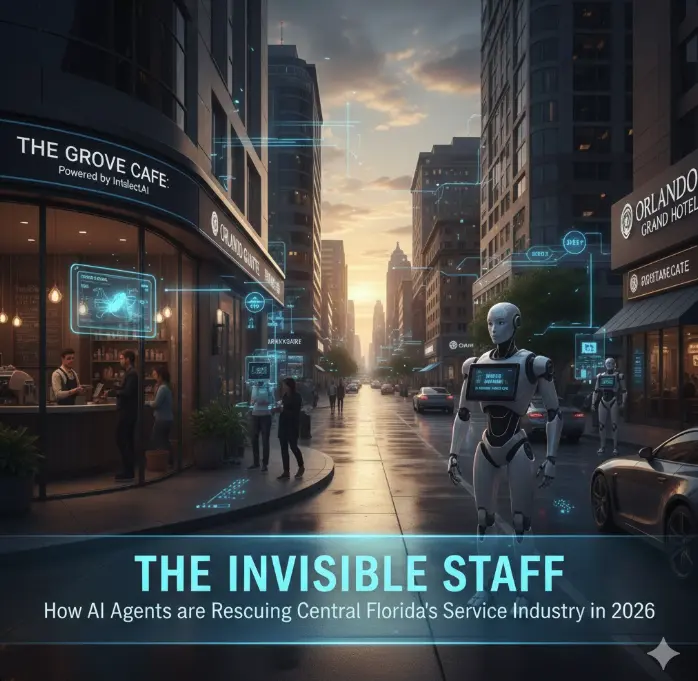
For years, the "help wanted" signs in the windows of Winter Park cafes and International Drive hotels were a permanent fixture of the Central Florida landscape. But as we move through 2026, those signs are finally coming down—not because the labor shortage has vanished, but because the "Invisible Staff" has arrived.
We have officially moved past the era of the clunky, frustrating chatbot. In its place, Central Florida’s service industry has embraced AI Agents. Unlike their predecessors, these agents don't just talk; they do.
From Answering Questions to Taking Action
In 2024 and 2025, if you messaged a hotel in Lake Buena Vista to ask for a late checkout, a chatbot might have directed you to a FAQ page. In 2026, an AI Agent receives that same request, checks the property management system (PMS) for housekeeping schedules, verifies the guest's loyalty status, approves the request, and updates the digital room key—all in roughly three seconds.
This is the "Agentic Shift." By connecting directly to APIs and back-end systems, these tools are acting as autonomous employees. According to recent 2026 hospitality outlooks, industry leaders are seeing a massive transition where "Discovery is the new Front Desk." Guests are no longer calling to book; they are using AI assistants that talk directly to the hotel's AI agents to negotiate the best room and rate.
Solving the Orlando Labor Puzzle
Orlando’s economy has always been a high-volume, high-pressure environment. With the 2026 "normalization" of the job market, local businesses are no longer just looking for "bodies" to fill roles; they are looking for efficiency.
-
Theme Park Efficiency: Take United Parks & Resorts (formerly SeaWorld) as an example. They have recently leveraged AI-driven queue monitoring to provide real-time, hyper-accurate wait times across 66 different rides. By using AI to analyze queue movement rather than relying on manual staff tallies, they’ve virtually eliminated the #1 guest complaint: inaccurate wait times.
-
The "Kitchen Manager" AI: In local QSRs (Quick Service Restaurants) across Orange and Osceola counties, AI agents are now acting as digital kitchen managers. They prioritize orders based on complexity and cooking times, ensuring that the burgers and the fries for a single order hit the heat lamps at the exact same moment
The Human Dividend: Service with a Soul
A common fear was that AI would make the "City Beautiful" feel robotic. The reality in 2026 is actually the opposite. By delegating "robotic" tasks (like split-bill processing, reservation modifications, and inventory tracking) to AI agents, the human staff is finally free to do what they do best: Hospitality.
When a server doesn't have to spend ten minutes fighting with a POS system to split a check for a party of twelve, they spend that time talking to the guests about local recommendations or the history of the neighborhood. This is what experts call "Workforce Augmentation"—AI isn't replacing the host; it’s making the host more effective.
The 2026 Reality Check: The Pros and Cons of AI Agents
As Central Florida businesses integrate these "agentic" workflows, it’s clear that the transition comes with both high-velocity benefits and significant hurdles. Here is the breakdown of what local business owners are experiencing on the ground in 2026.
The Pros: Why AI Agents are Winning
-
24/7 Precision Without "Burnout": In a 24-hour tourism hub like Orlando, guests have questions at 3:00 AM that can’t wait until 9:00 AM. AI agents provide instant, accurate resolutions for bookings, cancellations, and upgrades without the fatigue or "skill variance" of a human night shift.
-
Hyper-Personalization at Scale: 2026 is the year of "Segment of One." AI agents can remember a guest’s preference for a quiet room away from elevators or a specific allergy across multiple visits. Around 87% of consumers now value brands that recognize them personally, and agents make this "memory" possible for small businesses that don't have a massive CRM team.
-
Significant ROI and Operational Savings: Early data from 2026 shows that agentic AI can autonomously resolve up to 80% of common customer service issues, leading to an average 30% decrease in operational costs. For a mid-sized restaurant or boutique hotel, that’s the difference between a struggling year and a profitable one.
The Cons: The Challenges to Navigate
-
The "Erosion of Serendipity": One of the biggest risks in 2026 is over-automation. If every part of a guest’s Florida vacation is algorithmically curated, we risk losing the "human magic"—the spontaneous recommendation from a local bartender or the unexpected chat with a concierge that makes a trip memorable.
-
The Governance & Ethics Gap: As agents gain the power to act (like processing refunds or moving money), the risk of "hallucination-led errors" increases. Businesses must implement strict "guardrails" to ensure the AI doesn't misinterpret a policy and promise a guest a free week-long stay at a Luxury Disney-area resort.
-
The "Skill-Gap" Paradox: While AI agents solve the labor shortage, they create a "skills shortage." Business owners now need staff who can manage the AI—often called Agent Operations Specialists. This requires a shift in hiring from "entry-level service" to "tech-augmented hospitality."
-
Data Privacy & Trust: With Florida’s strict consumer data laws, businesses must be transparent. If a guest feels like an AI is "spying" on their preferences rather than "helping" them, it can lead to a total loss of brand trust.
How to Balance the Two
The most successful Central Florida businesses in 2026 are following the "80/20 Rule": they let AI agents handle the 80% of repetitive, data-heavy tasks, but they maintain a "Human-in-the-Loop" for the 20% of interactions that require high emotional intelligence, empathy, and complex problem-solving.
The Bottom Line for 2026
For Central Florida business owners, the message is clear: the goal for 2026 is to build a "Seamless Guest Journey." This means moving your data out of "messy PDFs" and into clean, AI-friendly structures. Whether it’s a boutique hotel in Mount Dora or a high-traffic bistro in Thornton Park, the winners this year are the ones who allow AI to handle the logistics so their people can handle the magic.
The labor shortage didn't break the service industry; it forced it to evolve. And in 2026, that evolution is powered by the most efficient employees Orlando has ever seen—the ones you can’t even see.
Categories
Recent Posts







ARE YOU LOOKIING TO SELL YOUR HOME FOR TOP DOLLAR? CLICK THE BUTTON BELOW TO GET STARTED
SELL YOUR HOME